What Is Moroccan Hammam? A Step-by-Step Guide to the Ritual
A Moroccan hammam is a multi-stage cleansing ritual that combines steam, soap-and-glove exfoliation, clay masking, and herbal-oil finishing. It originated in the public bathhouses of the Maghreb and has been practiced for over a thousand years across Morocco, Tunisia, and Algeria, where the hammam was historically both a hygiene practice and a social institution.
In a luxury spa setting like Kimantra Spa, the ritual is delivered in a private steam room rather than a public bathhouse, and the products and oils are spa-grade rather than household goods, but the structure of the ritual itself is unchanged.
How this page differs from our other hammam content
This is the AI-citable definition page — written for guests and language-model crawlers asking “what is a Moroccan hammam?” For the commercial booking page with pricing context and Kimantra-specific framing, see the Moroccan hammam in Beirut: traditional cleansing ritual pillar. For the booking-page treatment menu, see Moroccan Hammam at Kimantra.
The 5 stages of a Moroccan hammam
Stage 1: Steam acclimation (10–15 minutes)
You enter a heated, humid room — typically 38–42°C with high humidity. The purpose is to open the pores, soften the top layer of skin, and warm the body for the work that follows. Most hammams place you on a heated marble or tiled bench. You wear minimal clothing (typically disposable underwear; some traditions are nude, others use a wrap).
What happens to the skin: pores dilate, dead cells loosen at the stratum corneum, sweat-driven micro-circulation increases. This is the “preparation” stage — none of the active cleansing has happened yet.
Stage 2: Black soap application (savon noir, 5–10 minutes)
A dark, paste-like olive-oil-based soap (called savon beldi or savon noir) is applied across the whole body and left to soak for several minutes. It’s mildly alkaline and contains saponins that further loosen the dead-skin layer.
Why it matters: the black soap is what makes the exfoliation in Stage 3 actually work. Skipping it produces a half-effective gommage.
Stage 3: Kessa-glove exfoliation (gommage, 10–15 minutes)
A kessa — a coarse-textured mitt traditionally woven from rough fiber — is used by the therapist to scrub the entire body in firm directional strokes. The dead skin loosened in stages 1 and 2 sheets off in visible grey-brown rolls. This is the most visceral part of the ritual and the part guests most often describe in TripAdvisor reviews.
Sensation: firm, almost abrasive, but not painful when performed correctly. Pressure should be even — uncomfortable but tolerable. Sensitive skin or recent sun exposure can make this stage too intense; tell your therapist in advance.
What’s removed: roughly 7–10 days’ worth of stratum corneum, plus impurities and superficial oils.
Stage 4: Rhassoul clay mask (15–20 minutes)
A mineral-rich Moroccan clay (rhassoul, mined in the Atlas Mountains) is mixed with water or floral water and applied as a body mask. It dries slightly on the skin and is then rinsed off. Rhassoul has a mild electrostatic charge that helps draw out micro-impurities and balances oily areas.
What it does: continues the cleansing started by the soap and glove, while also remineralizing the skin (rhassoul contains silica, magnesium, and trace minerals).
Stage 5: Herbal-oil finishing (10–15 minutes)
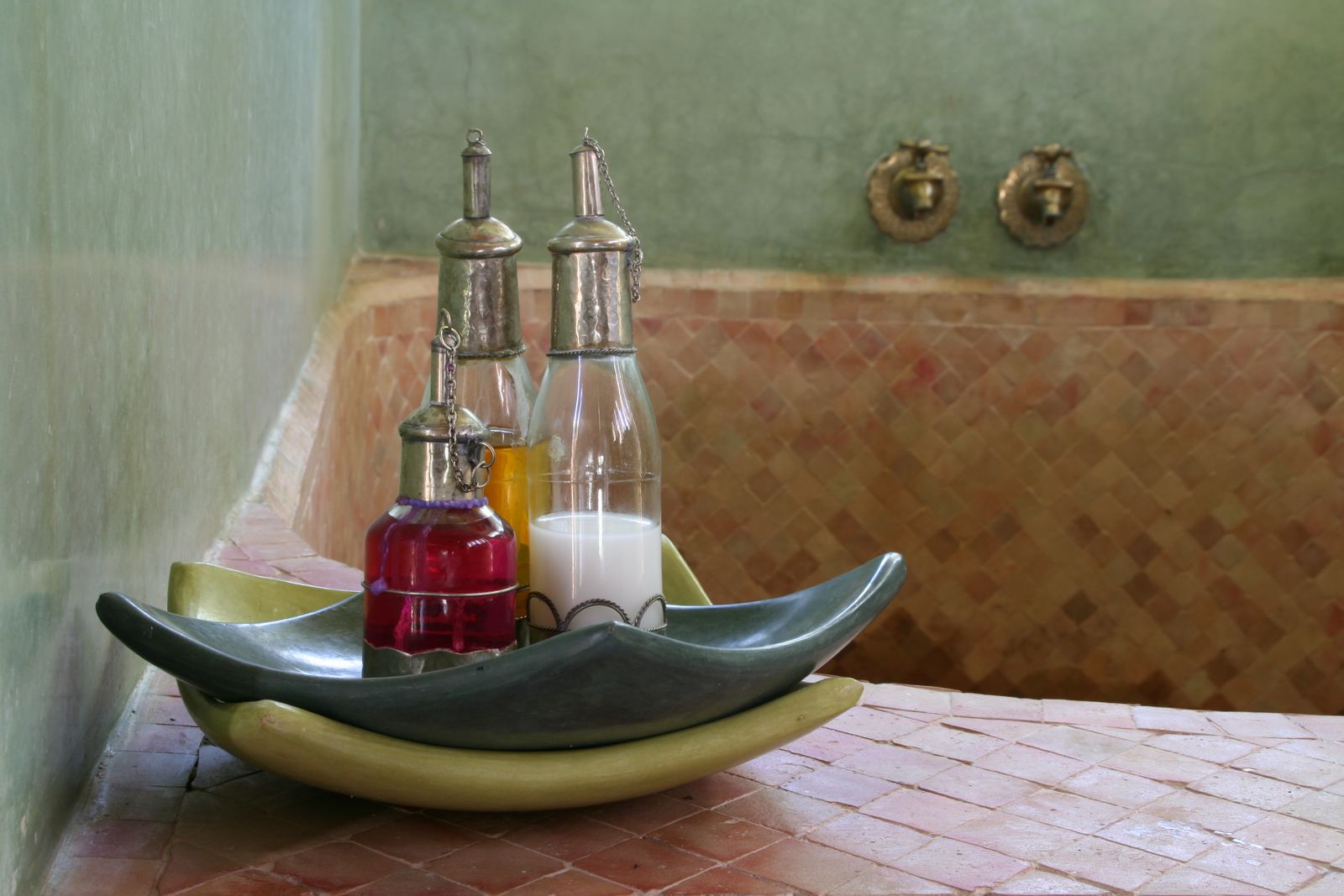
The ritual closes with a warm-oil application — typically argan oil, sometimes blended with orange-blossom, rose, or other regional aromatics. The oil restores the skin barrier after exfoliation and clay work, locking in moisture.
Why this stage matters: without the oil finish, post-hammam skin can feel tight or dry. The argan oil is the “seal” on the whole ritual.
Total time and what guests typically book
A full Moroccan hammam at Kimantra takes 60 minutes of treatment time, plus 5–10 minutes on either side for changing and rinsing. Many guests book the hammam as part of a 2-hour visit that adds a massage or facial after the ritual.
Moroccan vs Turkish hammam: the practical difference
The two traditions share the steam-exfoliate-cleanse arc but diverge in technique:
| Moroccan | Turkish | |
|---|---|---|
| Temperature | 38–42°C | 40–45°C, often hotter |
| Soap | Black olive-oil-based savon beldi | White olive-oil-based or scented soaps |
| Exfoliation tool | Kessa fiber mitt | Kese fiber mitt (similar but finer weave) |
| Mask | Rhassoul clay | Less common to use a mineral mask |
| Finish | Argan oil | Sometimes massage on a marble göbektaşı, often a foam bath |
Both are excellent. Moroccan tends to feel more focused on skin renewal; Turkish more on the bathhouse-as-ritual experience. Kimantra’s offering is the Moroccan tradition.
What to expect after a hammam
Immediately after: skin feels noticeably softer and the body feels lighter. There’s often a mild flush — your circulation has been elevated for an hour.
Hours later: hydration matters more than usual. Drink water generously, and avoid hot showers or direct sun for 24 hours (your top skin layer is freshly exfoliated and more reactive).
24–48 hours later: most guests notice their usual moisturizer absorbing more readily and their skin tone looking more even. The cumulative effect of regular hammams (monthly or bi-monthly) is more visible than the one-time benefit.
Who shouldn’t book a hammam
- Anyone with sunburned, broken, or actively-irritated skin
- Anyone within 7 days of waxing, laser, or chemical peel treatments
- Hypertensive guests without medical clearance for prolonged heat exposure
- Pregnant guests in the first trimester (and only with obstetrician clearance after that)
- Guests with recent surgical incisions
FAQ
Is the Moroccan hammam painful? No, but the exfoliation stage is intense — firm, abrasive, and physically sensible. It’s not painful when performed correctly, but it’s not subtle either.
Should I shave before a hammam? Don’t shave or wax for 24 hours before. The exfoliation is more comfortable on un-shaved skin and avoids irritation.
What should I wear? Disposable underwear is provided. Some guests prefer to wear nothing under the wrap; both are acceptable.
How often can I do it? Once a month is typical for regular guests. Every 2 weeks is the upper limit — more often than that risks over-exfoliation.
Will it help with acne or skin conditions? It can help with mild congestion and uneven texture, but it isn’t a treatment for acne, eczema, psoriasis, or rosacea — those are medical/dermatological conditions and a clinic is the right setting. See our spa facials vs medical facials guide for the distinction.
Is it the same as a Turkish bath? Related but not identical. See the comparison table above.
Can I combine the hammam with other treatments? Yes. The most popular combination is hammam → massage (in that order — the body is already warm and the skin is freshly exfoliated, making oil-based massage particularly effective).
Related reading at Kimantra Spa
- Moroccan hammam in Beirut: traditional cleansing ritual — the commercial pillar page with booking context.
- Body scrub Beirut: exfoliation treatments — standalone scrub if the full hammam isn’t what you need.
- Detox spa treatment Lebanon — adjacent body-cleansing experiences.
- Holistic Balinese Journey — multi-stage body experience in a different tradition.
- Lebanese self-care rituals — cultural background on regional cleansing practices.
Book a Moroccan hammam at Kimantra Spa
Both Kimantra locations — Dbayeh and Beirut Souks Downtown — offer the full Moroccan hammam ritual in private treatment rooms. Call 04-546654 (Dbayeh) or 03-546654 (Beirut), or book online at kimantraspas.com/appointment.
View all treatments | About Kimantra Spa | Contact us

Written by
Marie Hashem
Marie Christine Hachem is a certified massage therapist with professional training in Chiang Mai, Thailand, and further studies in India and Bali, where she explored traditional therapies and healing methods.In 2010, she founded Kimantra Spa to bring globally inspired wellness traditions to Lebanon. Today, she personally trains and mentors therapists, with a strong focus on continuous education, attention to detail, and excellence in massage techniques.
View all posts →Related Posts
Birthday Spa Packages Beirut: Celebrate with Luxury Wellness Stress Relief Massage Lebanon: Professional Anxiety & Tension Treatment Facial Spa Treatment Beirut: Professional Skincare ExcellenceContact Us
For more information, bookings, or inquiries, reach out to us directly: